Synopsis
Mining what Remains looks at the ecosystem of discarding, collecting, picking, selecting, refurbishing and trading used items across the Southwestern United States — a region marked by cycles of economic boom and bust, alternating between opportunity and crisis, wealth and precarity, growth and decline. In this context, the research looks at the thrifting economy and its coexistence with other foraging practices in the Sonoran Desert and the Rocky Mountains.
What does it take to see things value in items that other people cannot overlook? Can scavenging for second hand and vintage objects and materials help alleviate the exponential rise of living costs and solve some of the deep sustainability issues of the Southwest US? In the ephemeral ruins of suburban development and economic displacement, skilled scavengers—driven by knowledge and a desire to give new life to discarded items - create an economy of upscaling, catalyzed by local fairs, farmers’ markets, community celebrations, vintage and second-hand stores. The research is grounded in the ethnographic method and its sensory extensions, at the intersection of anthropology, history, design and cultural studies.

Churning the Frontier
The Southwest, often considered the final piece in the settler-colonial puzzle of the United States, generally designates “the Four Corner” states of Colorado, Utah, Arizona and New Mexico. This culturally diverse borderland is characterized by monumental and forbidding geography, extreme weather, cultural intersections and stark socioeconomic contrasts. Over the past few decades, the region has been experiencing a population boom, partly driven by economic growth, and partly by the echoes of the Great Recession of 2008 - 2010 and the COVID-19 pandemic of 2020 – 2021, which have put millions on the move, in search for more desirable or affordable living conditions. Suburbia is being churned at an accelerated pace: water scarcity, rising temperatures, and extreme weather events exacerbate economic pressures, including the rising cost of living, and a lack of affordable housing options.
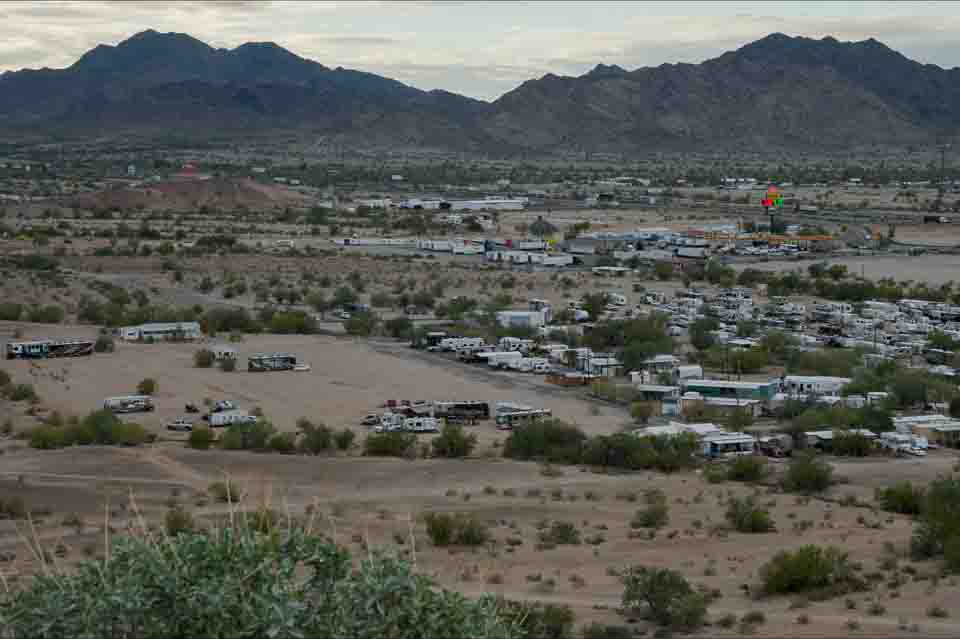
This topos is romanticized in tales of the El Dorado, the economic boom of the early 20th century that drew numerous European settlers out West to work in gas and oil fields, as well as coal, copper, silver, and gold mines, some of which still operate today. It is also reflected in the enduring myths of White America: the Old West, the land of cowboys, outlaws, sheriffs, gun fights and the displacement of indigenous people. In present times, lavish ski resorts and well-groomed towns dot the valleys and slopes of the Rocky Mountains, attracting millions of tourists to world-famous national parks like the Grand Canyon. Digital nomads and mindfulness enthusiasts flock to retreat centers in places famous for their healing capacities, while the rich fill up exclusive desert resorts. These spaces coexist uneasily alongside the violence of the militarized US - Mexico border in the Sonoran Desert, often a backdrop for political rhetorics. They are situated alongside towns filled with motels, mobile homes and RVs that belie the country’s “hidden homelessness” issue; the encroaching sprawl of middle-class settler America among consolidated farmland and Native American lands where nations strive to build resilience, in spite of environmental and socioeconomic vulnerability.


Ageing, mobility, sustainability
Active conversations about sustainability inhabit the imaginaries of our times. These are often handled by governmental institutions and NGOs devising strategies at various scales. However, people who make a living finding value in discarded items have already developed a specific toolkit, polishing their skills over the decades, at fairs, donation centers, workshops, in alleyways, sidewalks or fields. This knowledge is situated. Picking requires attunement to the specifics of place and time. Much like knowing which fruit is in season at a certain time, or what the best slopes are for certain types of herbs, knowing where to find different items of value, recognizing local demand throughout different seasons, and distinguishing between “vintage” and “second hand” items, all demand attention and expertise. This entangled knowledge is not typically taught in schools or workshops; rather it is acquired through experience, patience and due diligence in listening and learning from one’s surroundings. It is a process of becoming, in which people often draw from life-time experiences, memories and knowledge.
For many such ‘foragers’, this is a lifelong pursuit that often provides alternative lifestyles. It can travel with people in time and space: well into retirement age, and then on the go, when / if they leave settled homes behind to take up 21st century RV nomad lifestyles willingly, or by necessity, to cope with economic pressure. While many young people might participate in this ‘economy of nostalgia’, driven by the popularity of second-hand clothing on social media, the truly successful, professional thrifters are often more seasoned. Near communities of snowbird retirees or RV parks that support people who have chosen or were forced into a “nomadic” lifestyle, vintage item markets flourish. A different crowd shops at second-hand stores or farmers’ markets in affluent, chic towns or hip neighbourhoods in the big cities. Traders and sellers may vary, but the pickers and suppliers often remain the same.
Second-hand foraging is a choice—often compelled by necessity— to live sustainably and frugally on the fringes of a stratified society that once glorified consumption but now has to reckon with the consequences of that lifestyle.


Wild food picking and cooking in the desert
While the Southwest now attracts adventure-bound settlers from all walks of life, it is also home to dozens of indigenous nations, including the Tohono O’odham, Navajo, Hopi, Pima, Zuni. Questions of sovereignty and autonomy have been urgent since the 1500s, after the arrival of the first Spanish missionaries and troops. Some tribes have called this region home for thousands of years, since before the rise of the Aztec Empire, while others were displaced here during the 19th century, after the closing of the American Frontier. Wild food foraging in the Sonoran Desert and the high mountain country was once widespread. On Indian reservations, going out in the Sonoran Desert to forage for saguaro or prickly pear cactus fruit, or cholla tree buds is still an important part of education programs and family tradition. In communities confronted with a rampant health crisis largely caused by the pervasiveness of fast food, local NGOs and communities strive to recover and preserve old knowledge that can become useful today.
Knowing what’s in season and how to make economic value from what may seem like simple roadside growth, is part of the intangible heritage of the peoples of the Sonoran Desert.
Field Sites
Research for ‘Mining What Remains’ is based in field sites across the US Southwest, most notably: Coal Creek, Boulder and the greater Denver metropolitan area in Colorado; the former mining town of Ajo, alongside Why and Tucson in the Sonoran Desert, neighboring the Tohono O’Odham Nation and the state of Sonora (in Mexico), and the Verde Valley of Arizona.


Current State
Research for the project is currently under way, with data collection ongoing, including longitudinal ethnographic studies in several sites.


Outcomes
We are working on a feature documentary film called The River of Stuff, and several short film and installation outputs in sensory ethnography, including in photography, sound, web and expanded media formats.