Synopsis
In the lush, forested mountains of southern Albania, many people earn their living by gathering wild herbs. Some climb mountain slopes to collect sage and oregano, while others scale trees to harvest lime blossom or common ivy. Around sixty different species are sold and exported worldwide. This project explores the large-scale and ambiguous economy based on the collection of wild herbs.
Research Enquiries
Recognizing its abundant natural resources, Albania has a long history of collection and export. Under the communist regime, collection was organized and strictly controlled by the state. After the end of the dictatorship, most forests and mountain pastures were never privatized; they remained state-owned and, in theory, were handed over to the municipalities for management. Pre-communist claims to land use rights, along with newer regulations for conservation areas and national parks, add layers of complexity. Yet, in practice, most forests and mountain pastures are seen as legitimate commons – open for people to gather herbs freely. What emerges is a business based on fuzzy commons.
Against the backdrop of outmigration, the question of who stays and why, reveals the world of commercial herb collection in Albania. The primary incentive is financial gain and the goal of building a stable future for one’s family despite the challenges like poverty and migration. In the Toskeria region of southern Albania, where our research takes place, herb collaction is not a loose assembly of individual collectors. Instead, it is an extensive network of people dedicated to herbs, whether as collectors, traders or helpers. The collected plants become the nexus of human relationships, a resource to which people devote themselves with care. Economic strategies are tied to maintaining social relationships – for both collectors and traders.
The limits of these resources —both ecological and social —are being tested. This encompasses questions of legality and informality, the regenerative capacity of natural resources, the need to protect the beauty and integrity of the region, the resilience of friendships and agreements, and the importance of the global plant trade. Interestingly, the self-organized herb business in southern Albania is intertwined with the international economic realities of quality testing, certifications and labels such as ‘wild’ and ‘organic’. A surge in global demand sparks local opportunities that cannot be missed. However, when demand suddenly declines, debts accumulate and livelihoods face immediate, existential threats.
So far, our main research questions are: What drives the rise and fall of Albanian foraging practices? What is the nature of relationships between people and plants, and how do ecological awareness, national politics and economic aspirations shape the world of wild herbs? How should crisis and survival be understood at the edge of capitalism in this moment in time? What will happen in the future to Albania’s fuzzy commons-in-practice? What forms of human-environment relations are emerging in the twilight of global commodity chains here, on the edge of the EU? And what does the entanglement of herbs, aging, poverty and lost hopes tell us about the inconspicuous corners of the world?
Ecotourism, Investment, and the Commons
Embedded in the global debates on the protection of the environment in the face of the ongoing and increasingly palpable climate catastrophe, Albanian ecotourism stands at a crossroad. On one side, it’s shaped by growing national and local awareness and the push for sustainable tourism; on the other, it faces significant influence from international, particularly Western, influence. For over thirty years, an interdisciplinary cooperation of independent lawyers and ecologists fought for the protection of the Vjosë River, with substantial help of Patagonia’s public relations department, among others. Meanwhile, the government’s development agenda has facilitated and pushed beach tourism along Albania’s riviera, creating seasonal jobs but hardly stopping the exodus of the younger generations. While some families ecotourism as a hopeful prospect, particularly in the context of the establishment of the Vjosë River National Park in 2023, most young people still prefer to move away, leaving mainly elderly people behind. This sense of being left behind is reflected in empty villages, where a handful of families remain, as many long left in search of a better life.
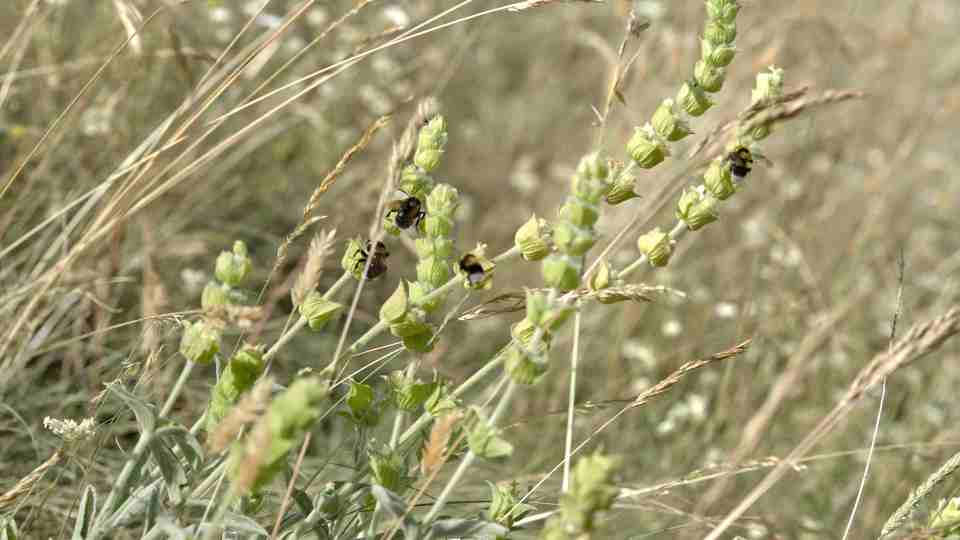
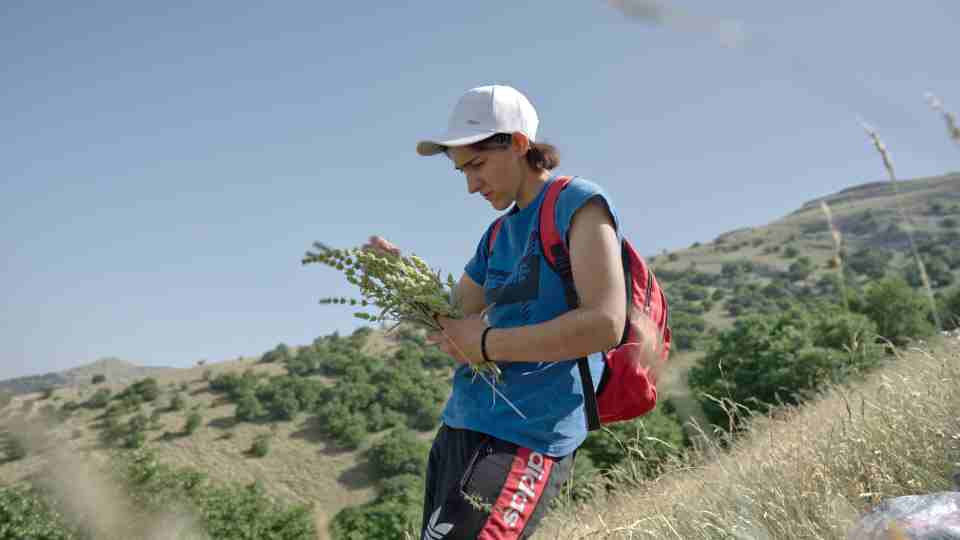
Though communism in Albania ended 35 years ago, its legacy persists in the commons of the Albanian countryside: communally owned, cultivable land, and its diverse resources. Herbs and flowers that grow all year round were traditionally harvested not only by people but also by grazing animals. The decline in pastoralism in some remote areas —along with climate change —is partly responsible for the changing environment, especially the reported decline in herb yields from year to year. Yet these narratives are more complex than it seems at first sight. Today’s far-reaching business around herbs itself has its weak points and uncertainties. Demand surges for essential ingredients in cosmetics, natural medicinal products and teas, are punctuated by regular collapses in the capitalist trade system. This instability reaches even the smallest villages, where, for example the harvested sage may suddenly go uncollected. Between the harvesting of herbs on southern Albania’s sunny hillsides and the sale of end products in Europe or the US, a web of informal and formal relationships with numerous players, speculations, and investments that work or fail, keep the herbal economy alive.
For those who stay and those who return, gathering herbs serves as both an vital source of income and a meaningful connection to the environment. What we encounter is not only economic precariousness, but also a sense of autonomy. This autonomy —the freedom to work in the forest rather than a salaried job —stands in stark contrast to the growing array of forest of regulations, subsidies, and incentive schemes associated with Albania’s EU membership candidacy, as well as the widespread awareness of the corrupt schemes that go along with it.
Methodology
We seek to approach our questions in a long-term ethnographic study with a distinct sensory and visual angle. Step by step, over a period of several years, we will accompany collectors to their collection sites, experiencing the strength, perseverance and effort required for a good harvest from nature. We will engage in discussion about their families, business and politics. We will learn about the fluctuations of prices and their strategies to deal with them; we will visit them in their homes and witness the challenges of drying herbs in the different seasons. We will follow herb traders to the villages to pick up plants and keep going to the weekly markets where villagers sell their herbs. We will spend long hours in herb shops, helping with tasks such as sorting, cleaning, packing bags and loading trucks. We plan to frequently discuss our observations with local experts and people familiar with the export business.
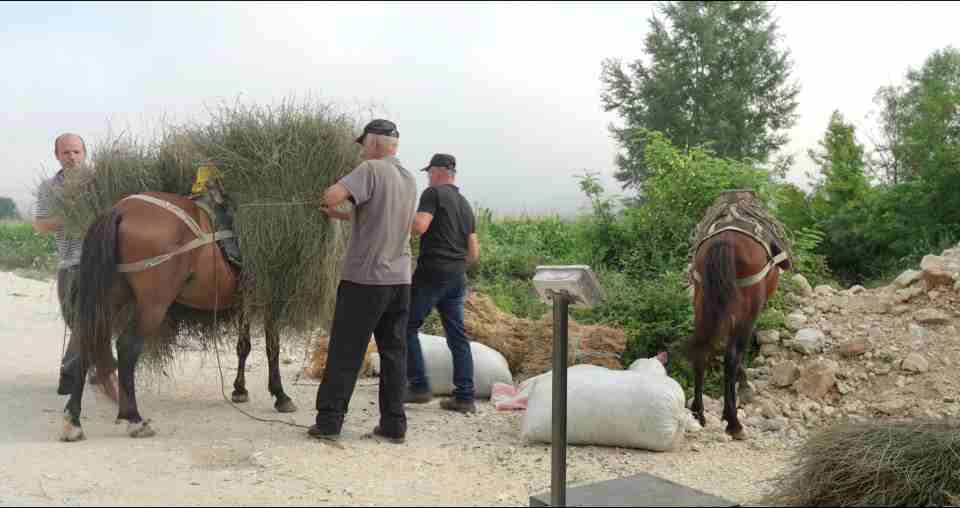
With a few selected protagonists, we have begun working on a documentary film. Using film as a research method requires intensive collaboration and deep consent. At the same time, the camera lens provides distance and the opportunity for self-reflection —for us as filmmakers and for the protagonists, who often gain new insights into their own practices and their meanings when they rewatch the footage with us. The sound of a place grants entrance into the sensorial, letting in not only stories but also the summing, stepping, cutting, the dropping of sweat, and the singing of the muezzin. The fictional aspect of documentary filmmaking becomes particularly pronounced in a field charachterized by precarious business, where scenes sometimes appear performance on the playful and humorous stage of existence. The work on a film also highlights sensitivities and foregrounds the question of representation – what can be shown to the world and what should remain hidden?
A Glimpse into ‘Pelivan’s Map’
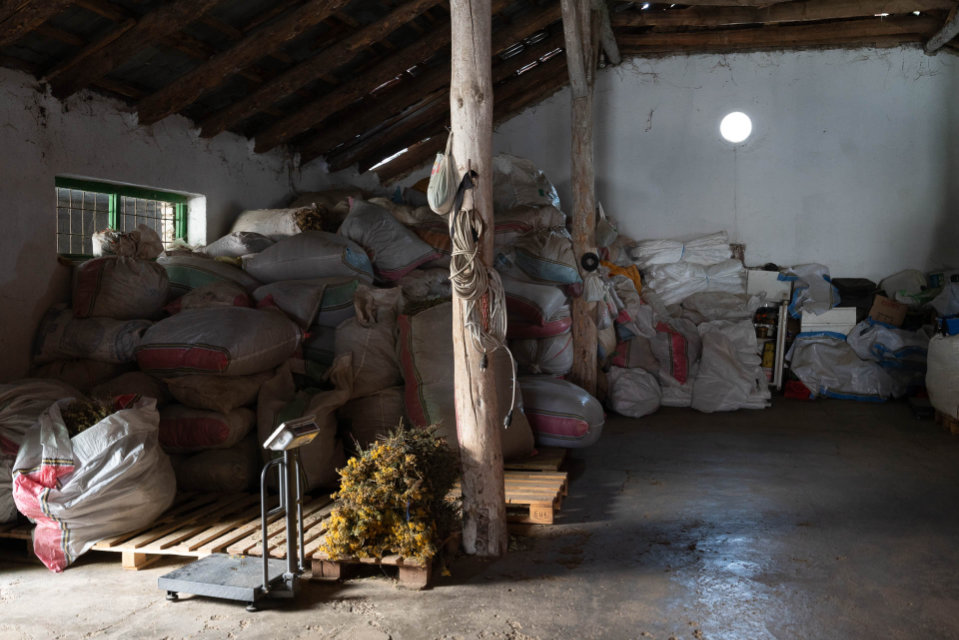
In the region surrounding the small town of Këlcyrë, there are three main traders who engage in both humorous and sometimes suspicious competition. Our focus is on the life Pelivan, one of these traders and his family. Pelivan used to be a shepherd and occasional collector and only recently established himself as a businessman. His warehouse located on the riverbank of the Vjosë – an erstwhile jam factory – is stacked with bags full of sage, oregano, thyme, lemon balm, wild apples, ivy, mountain tea, camomile, immortelle, lime blossom and lime leaves, rosehip, verbena, rose petals, elderflowers and much more. This warehouse represents the sheer scale of collection and the labour involved, but also highlights the abundance of natural resources. At the same time, it symbolizes the risky investment enviroment, balancing the continuity of collection with the fluctuating demands of the market.
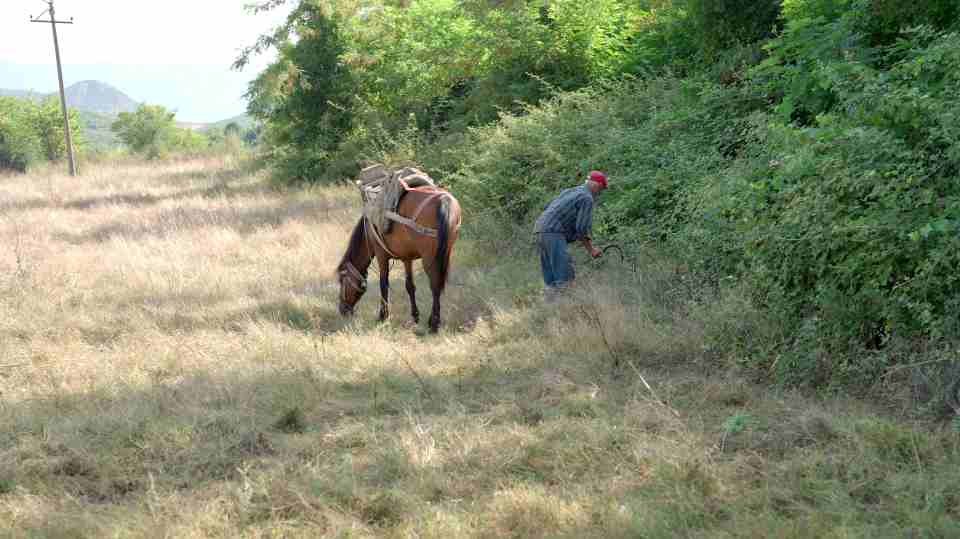
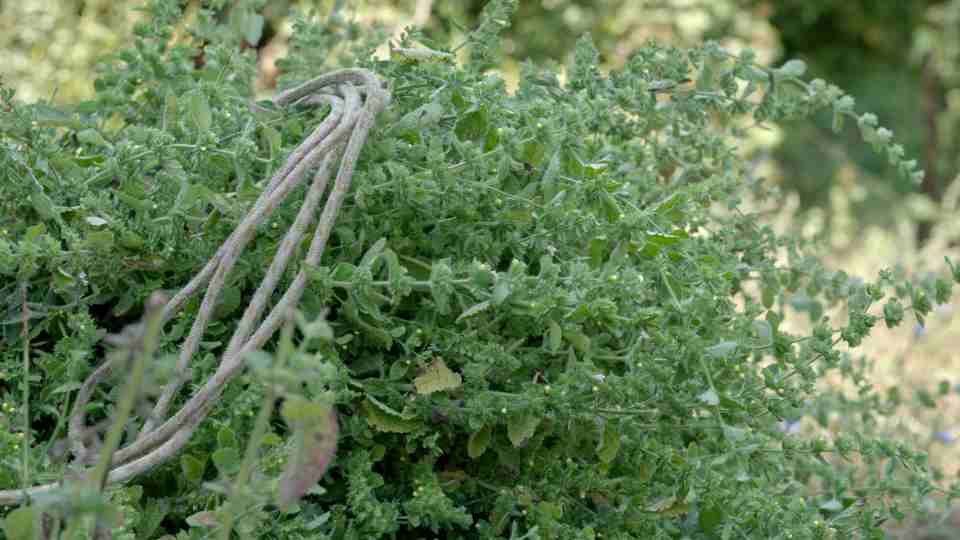
The knowledge of plants and the practices of collecting, drying and storing the herbs until they are picked up, is a world in itself —one that we encounter in many family households in the villages of the region. Two of our protagonists, a childless couple in their 60s living in Kosinë, earn around 18 euros a week together. Every morning at 6 a.m., the man rides their single horse down to the village, gleaning the gravelled roadsides of the flat land for melissa and verbena. He finds that melissa works much better for him and his immobilized back which he got through a construction work injury 20 years ago. The monthly wait for the young small trader to arrive and pick up the huge batches of green is not only a necessity for an income but also always means a friendly encounter of reciprocal trust and support between forager and trader, framed by the ceremony of talking politics and philosophy and enjoying some homemade raki.